+91 83742 09209
 konakalla.vamsi99@gmail.com
 [Clinic Address, City]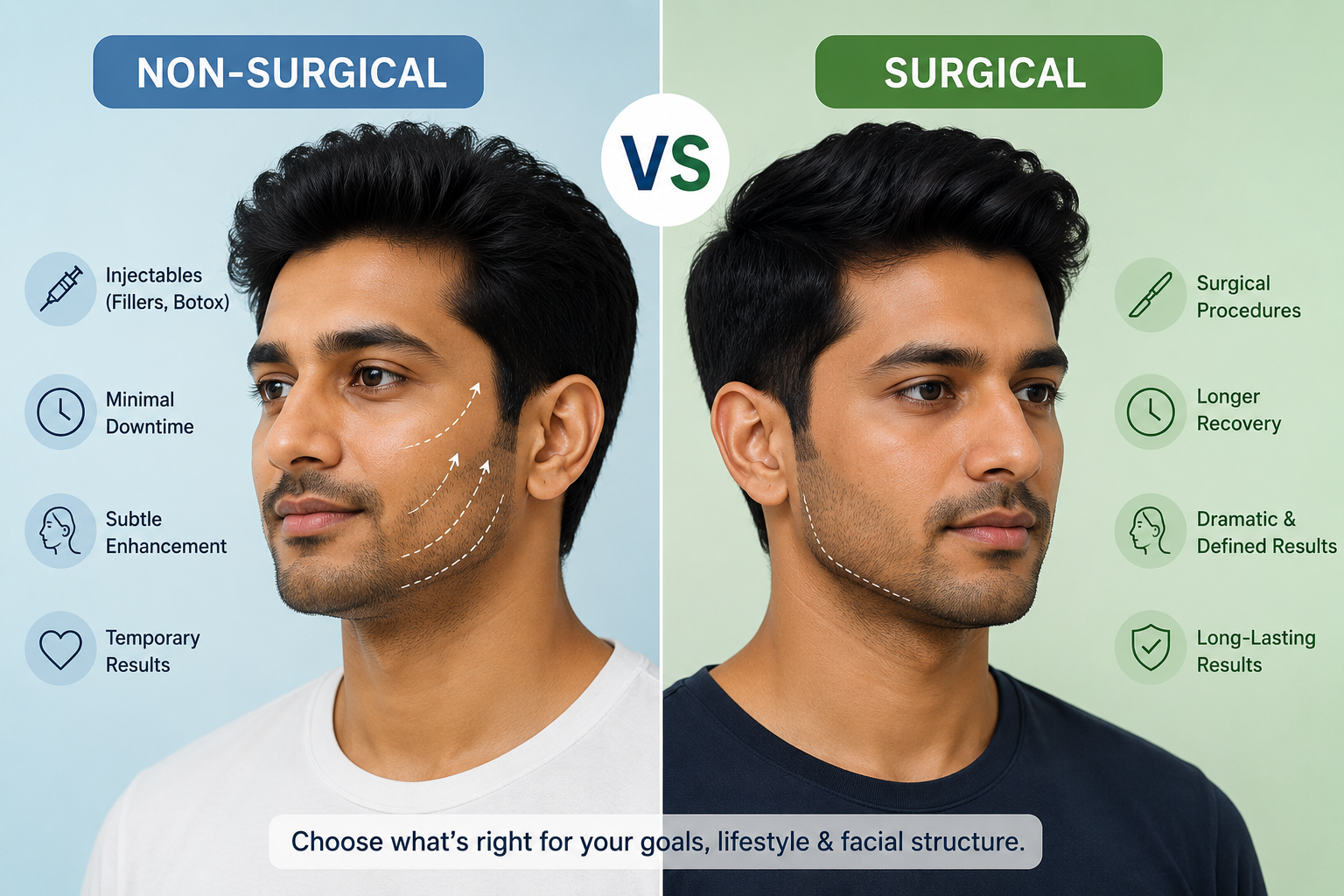
Facial contouring refers to a range of procedures designed to reshape the facial structure, sharpen the jawline, highlight the cheekbones, or restore facial symmetry. Depending on your anatomical goals, budget, and willingness to undergo downtime, you can choose between non-surgical and surgical options.
Non-surgical facial contouring utilizes injectables like dermal fillers and Botox to sculpt the face. For example, fillers can be placed along the jawline and chin to mimic the look of a stronger bone structure, or in the cheeks to create a lifting effect. Botox can be injected into the masseter (jaw) muscles to reduce their size, softening a square jawline into a more oval shape.
Non-surgical contouring offers instant results with minimal downtime, but surgical contouring provides permanent structural changes for complex bone discrepancies.
Surgical facial contouring, performed by an oral and maxillofacial surgeon, involves modifying the underlying bone. Procedures such as genioplasty (chin repositioning), mandibular angle reduction (jaw shaving), or orthognathic surgery structurally alter facial proportions. These surgeries are performed under general anaesthesia and require a healing period, but the results are permanent and can correct functional skeletal issues.
Choosing the right contouring approach for you
Both paths have distinct advantages depending on your clinical needs and lifestyle factors:
- Downtime: Non-surgical treatments have zero downtime, while surgical contouring requires 1 to 3 weeks of swelling management.
- Permanence: Non-surgical injectables require maintenance sessions every 6 to 18 months, whereas surgical outcomes are permanent.
- Skeletal Discrepancies: Severe facial asymmetry, overbites, or underbites usually require surgical repositioning for stable results.
- Suitability: A detailed assessment of facial bone structure, skin elasticity, and treatment goals will guide the correct choice.
The best approach starts with a comprehensive consultation to evaluate your facial features and discuss what is safe and effective for your anatomy. Consult Dr. Vamsi Krishna Konakalla for an expert evaluation. This content is intended for patient education and is not medical advice.
 Call Us :