+91 83742 09209
 konakalla.vamsi99@gmail.com
 [Clinic Address, City]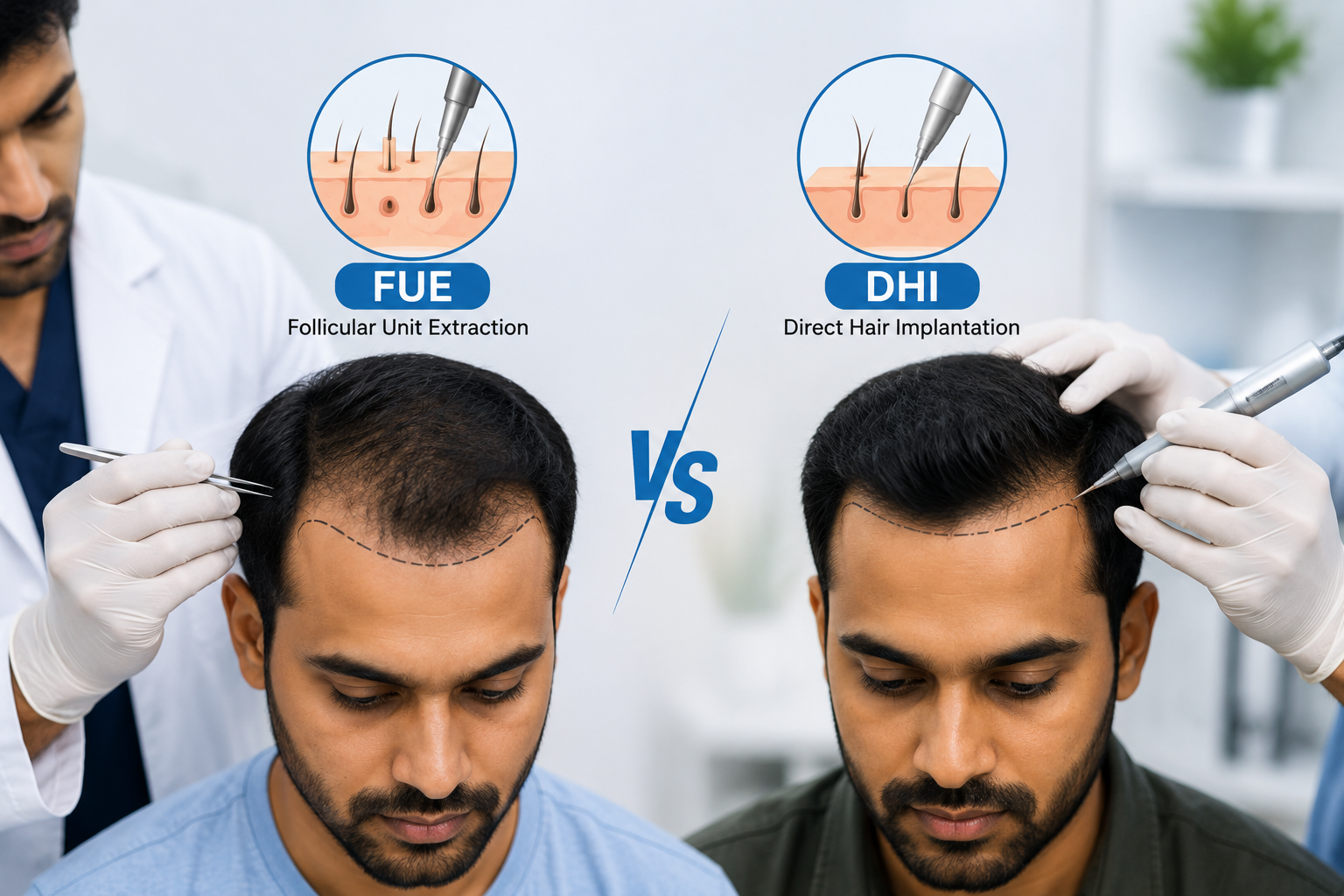
FUE (Follicular Unit Extraction) and DHI (Direct Hair Implantation) are two of the most widely used hair transplant techniques today. Both work with the same basic principle — moving healthy hair follicles from a donor area, usually the back or sides of the scalp, to areas experiencing thinning or hair loss. The difference lies mainly in how the follicles are extracted and implanted, and this is often what patients want to understand before deciding which approach may be suitable for them.
In FUE, individual follicular units are extracted one at a time using a fine punch tool. Once extraction is complete, tiny recipient sites are created in the treatment area, and the follicles are then implanted into these sites. This two-step process gives the surgeon flexibility in planning the angle, direction and density of the transplanted hair, particularly useful for larger sessions or more extensive areas of hair loss.
Neither technique is universally "better" — the right choice depends on your degree of hair loss, donor hair availability, the area being treated, and your surgeon's assessment during a consultation.
DHI follows a similar extraction process, but implantation is done directly using a specialised implanter pen (often called a Choi pen), which extracts and places each follicle in a single step without first creating a separate recipient site. Some surgeons consider this approach to allow finer control over implantation angle and depth, particularly for hairline design, though it can take longer for larger sessions.
Key factors that influence which technique may suit you
Choosing between FUE and DHI isn't simply a matter of preference — it depends on an assessment of your scalp, hair loss pattern, and treatment goals. Some of the factors typically considered during a consultation include:
- The extent and pattern of hair loss, and how much coverage is needed.
- Availability and quality of donor hair at the back and sides of the scalp.
- Whether the priority is hairline design, density, or both.
- Time available for the procedure, since techniques can differ in session length.
- Any relevant medical history that may affect suitability for either approach.
Both FUE and DHI are established, widely practised techniques, and each has its own considerations around technique, planning and recovery. Rather than relying on generic comparisons, the most reliable way to know which technique — or combination of approaches, such as Sapphire FUE — is right for you is a detailed, in-person consultation where your scalp and goals can be properly assessed. This article is intended for general patient education and is not a substitute for individual medical advice.
 Call Us :